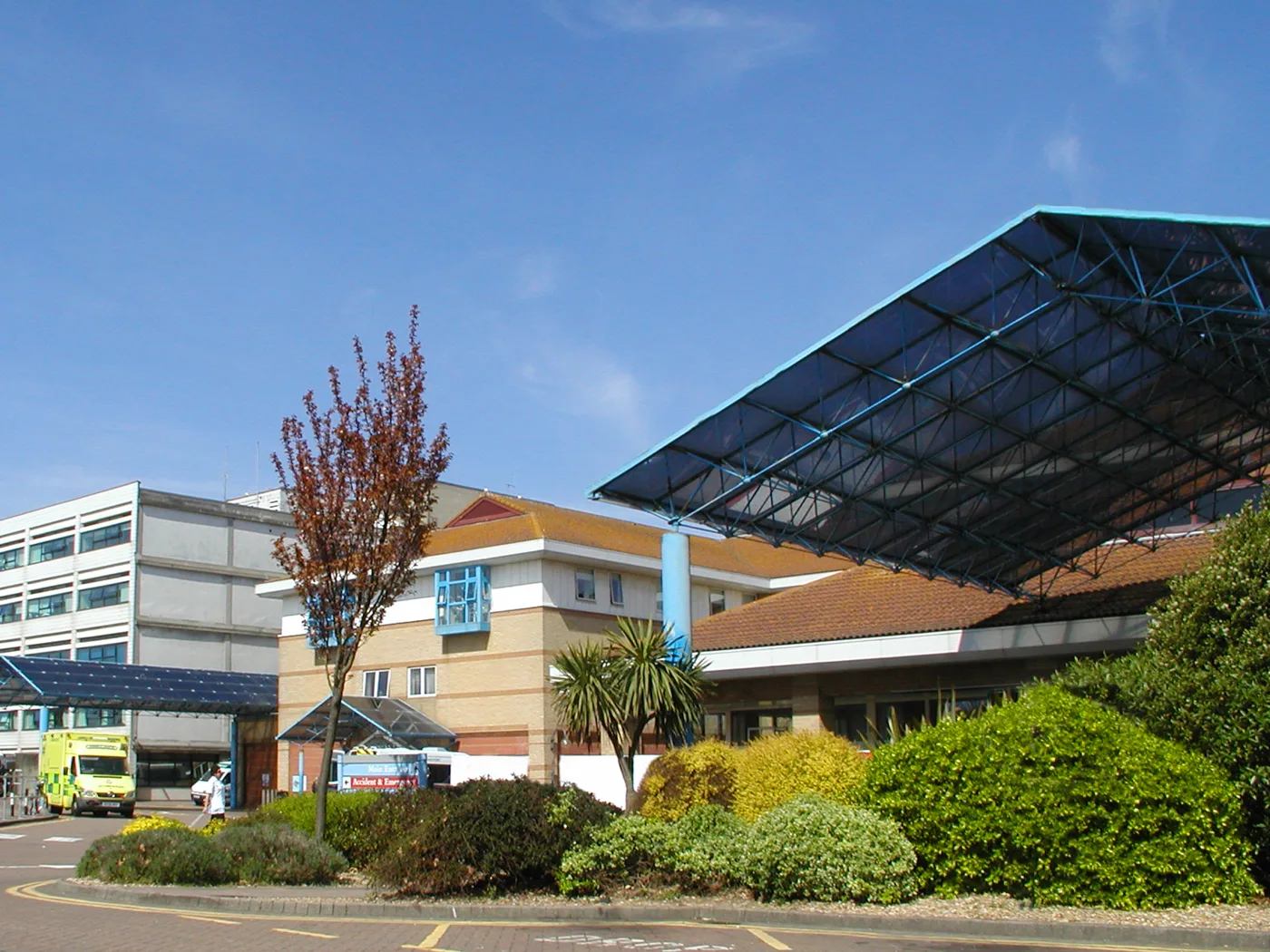

Inspectors watched a body prepared for release from a public footpath, and found 10 major failings in Worthing Hospital's mortuary, four repeated from 2022.
Inspectors standing on a public footpath behind Worthing Hospital were able to watch a body being prepared for release from the mortuary. The regulator has now published what it found, and it runs to 10 major and six minor breaches of the standards the mortuary is licensed against.
The Human Tissue Authority inspected on 7 and 8 July 2026. Its final report was published this month. Four of the failings had already been raised at the previous inspection in 2022. The HTA lists them as T1c, T2b, PFE2a and PFE2c, and it told the trust in its feedback meeting that “sufficient action had not been taken” in the years since.
Worthing Hospital holds the licence. Three other hospitals run by University Hospitals Sussex NHS Foundation Trust sit under it as satellite sites: St Richard’s in Chichester, the Royal Sussex County in Brighton and the Princess Royal in Haywards Heath. Some findings below are Worthing’s alone, and some are shared. We have said which throughout.
The body store could be seen from a footpath
The most serious of the premises findings is about who can see into, and get into, the Worthing body store.
The mortuary office fire exit door is routinely propped open in hot weather to help ventilation. The CCTV camera covering that door was not working. When the door is open, the report says, it “provides unrestricted access to the body store”, and there is “a direct line of sight from a publicly accessible footpath into the body store”.
The inspectors did not take this on trust. From that footpath, the report records, “the inspection team was able to observe a body being prepared for release”.
They found a second route to the same problem. The funeral directors’ entrance doors at Worthing were slow to close and lock. After one release, staff left the area with the doors still substantially open, giving the same line of sight from the footpath.
Two other security points at Worthing:
- The access control system at Worthing and St Richard’s had an ongoing failure, so access restrictions “could not be consistently assured”. The trust had reported this to the HTA itself before the visit, and said the working system used at the Brighton and Haywards Heath sites would be brought in during August 2026.
- The condenser units serving the Worthing mortuary sit in the cafe garden directly above it. A gate had been fitted to keep people out. At the time of the inspection it was insecure and its padlock was not in use.
The HTA records that the trust submitted enough evidence to close the CCTV and gate finding before the report was published.
Families could be shown the wrong body
The finding with the clearest consequence for bereaved families is about identity checks at viewings.
The mortuary does not routinely check a minimum of three identifiers on the body against the details a family gives when they arrive. The viewing procedure contains no final identity check before a family goes in. Because one team prepares the deceased and another team runs the viewing, the report says, “there is no final verification that the deceased presented for viewing matches the details provided by the family”.
The HTA sets out the consequence in one sentence: “This poses a risk of bereaved families viewing the wrong body.”
It nearly happened. Bereavement staff told inspectors about a recent near miss. It was caught before the viewing, but not by the identity process. Staff spotted an unrelated inconsistency. That incident was not reported to the mortuary’s designated individual or to the HTA.
The same inspection found no records showing that bereavement staff who run viewings had been trained for the job, and none showing they had been assessed as competent at it.
This identification failing was also found at the Royal Sussex County Hospital in 2022.
Twenty-one reportable incidents never reached the regulator
Inspectors reviewed the mortuary’s incident logs for the previous 24 months. They found 21 incidents that met the HTA’s reporting threshold and had not been reported to the HTA. Sixteen of those were potential near misses with no harm recorded.
All 21 had been logged and investigated locally. The regulator was simply not told.
Eight bodies left deteriorating in the fridge
Staff were carrying out regular condition checks on bodies in refrigerated storage. What they were not doing was acting on what those checks showed.
Inspectors found seven cases at Worthing and the Royal Sussex County where a body had stayed in refrigerated storage for more than 30 days despite documented deterioration. In each case the post mortem and coronial processes were finished and freezer storage was available somewhere in the trust. The bodies stayed in the fridge and carried on deteriorating.
The designated individual then ordered condition checks and a full review across all four mortuaries, which turned up one more case. All the bodies were moved to freezer storage, and inspectors verified on the second day of the visit that the transfers were done. In total, eight cases met the HTA’s reporting threshold and were reported.
No similar cases were found at St Richard’s or the Princess Royal.
The same shortfall was found at the Royal Sussex County in 2022.
Live CCTV of viewing tables was on show in the security office
Security staff had unrestricted access to CCTV covering what the report calls “highly sensitive areas”. That includes the cameras over the viewing tables at Worthing and St Richard’s, and the cameras inside the body storage fridges at St Richard’s.
During the inspection, live feeds from those cameras were openly visible on monitors in the security office. The trust could not show inspectors what stopped anyone in that room watching them.
The state of the Worthing mortuary itself
Under the standard requiring premises to be clean and well maintained, the HTA recorded “significant areas of damage, wear and poor condition”. At Worthing specifically:
- The body store floor was heavily stained and “appeared to be reaching the end of its serviceable life”, which the report says risks ineffective cleaning and decontamination.
- There was a heavy build-up of dirt in the body store drains.
- A water leak above the body store had been fixed, but the hole made in the ceiling to reach it was still unrepaired.
- The porters’ lobby door and frame had multiple areas of exposed wood.
- Cardboard boxes were stored directly on the body store floor, and the store was cluttered with items on the floor.
The equipment was in a similar state. Worthing’s refrigerated units had dented doors, raising concerns about the integrity of the units and their door seals. Transfer trolleys were rusting, and there was heavy rust on the red storage cupboard in the body store.
On the day of the inspection, Worthing’s freezer unit was out of service, leaving the site with no on-site freezer capacity at all. That failure had not been escalated to the designated individual or reported to the HTA.
The report also notes that refrigerated storage at Worthing and the Royal Sussex County cannot take the range of body sizes the service routinely receives. The HTA says this “poses a risk of accidental damage to the deceased”, and that recent near-miss incidents reported by the trust already show it.
In a separate advice note, inspectors recorded “substantial standing water” along sections of the route used to move deceased patients from Worthing’s wards to the mortuary, which staff had to move them through.
Consent records for retained tissue were incomplete
The mortuary receives paperwork from the Coroner’s Office saying whether tissue should be kept or disposed of. During a traceability audit, inspectors found several cases where tissue was being stored with incomplete consent documentation.
Key sections were blank, including the relationship of the person who gave consent. The mortuary had not gone back for the missing information. The effect, in the HTA’s words, is that it “is unable to demonstrate that consent was obtained from the person highest in the hierarchy of qualifying relationships”, which is what the Human Tissue Act requires.
Separately, the mortuary relies entirely on the Coroner’s Office telling it when an inquest has ended. It has no process for checking the status of open inquests itself, so tissue may be held longer than it needs to be. That finding was also made in 2022.
Where the failings fell
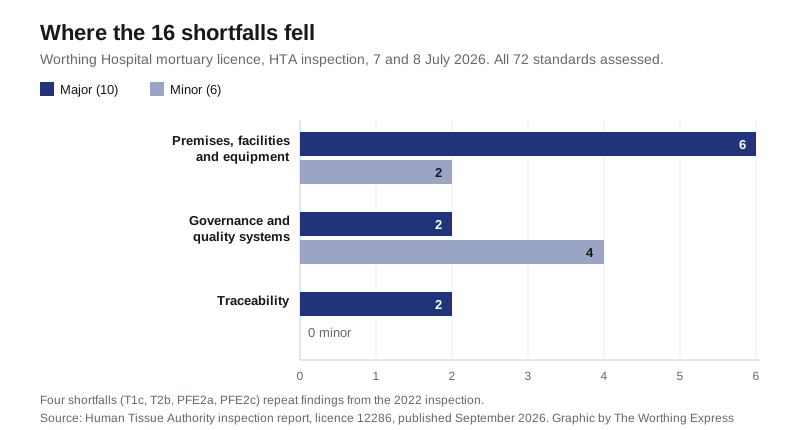
The shortfalls were found against three groups of standards. Premises, facilities and equipment took six of the majors and two of the minors. Governance and quality systems took two majors and four minors. Traceability took two majors and no minors.
All 72 of the HTA’s licensing standards were assessed. The audits themselves came back clean: inspectors checked the identification records of 23 bodies across the four sites against the electronic register and the paperwork, and audited tissue from 10 post mortem cases, and found no discrepancies in either.
What happens next
The HTA has assessed the mortuary as still suitable to be licensed, “subject to corrective and preventative actions being implemented to meet the shortfalls identified”.
The designated individual has to submit a corrective and preventative action plan within 14 days of receiving the final report. The HTA then sets out what evidence it wants to see that each action has actually been done. It says progress on the repeated 2022 findings “will be monitored through an agreed corrective action plan”.
This was the fifth inspection of the Worthing licence, which has been held since August 2007. The report was sent to the designated individual to check for factual accuracy on 24 August 2026 and returned on 7 September 2026, so the trust had seen and checked the findings before publication.
University Hospitals Sussex has published nothing about the inspection in its own newsroom. We checked on 18 September 2026 and will add the trust’s response here if it issues one. The trust’s other open question in the town is the Worthing Integrated Care Centre, whose water system has pushed back its handover.
What it means for you
- If you are arranging to view a relative at Worthing Hospital, the HTA has told the trust to put a three-point identity check into the viewing procedure. Until it is in, there is no final check that the person you are shown is the person you were told about. You can ask staff what identifiers they have checked.
- If a relative’s body is being held at the mortuary, the HTA’s concern is about how long bodies stay in refrigerated rather than freezer storage once the coroner has finished. You can ask which type of storage is being used and why.
- If you have a concern about how a mortuary is run, the HTA takes them directly through its own contact form, and it is the regulator rather than the hospital that can act on the licence.
- The failings are about the mortuary licence and the care of the deceased. They say nothing about clinical care elsewhere in the hospital, which is inspected by the Care Quality Commission, not the HTA.
Frequently asked questions
Who inspected the Worthing Hospital mortuary?
The Human Tissue Authority, which licenses mortuaries under the Human Tissue Act 2004. It is a different regulator from the Care Quality Commission, which inspects clinical care.
When was the Worthing Hospital mortuary inspection?
On 7 and 8 July 2026. The final report was returned by the trust on 7 September 2026 and published this month. It was the fifth inspection of a licence held since August 2007.
How many failings were found?
Ten major and six minor shortfalls, against 72 licensing standards. Four of them, coded T1c, T2b, PFE2a and PFE2c, repeat findings from the 2022 inspection.
Has Worthing Hospital’s mortuary lost its licence?
No. The HTA assessed it as still suitable to be licensed, subject to corrective and preventative actions. The mortuary’s designated individual has 14 days from receiving the final report to submit that action plan.
Which other hospitals does the report cover?
St Richard’s in Chichester, the Royal Sussex County in Brighton and the Princess Royal in Haywards Heath, all satellite sites on Worthing’s licence. Some findings apply to one site and some to several, and the report says which.
Did inspectors find any body wrongly identified?
No. Inspectors audited identification records for 23 bodies across the four sites and tissue from 10 post mortem cases, and found no discrepancies. The major finding is that the viewing procedure has no final identity check, which the HTA says risks a family being shown the wrong body.
Sources
- Post mortem inspection report, 7 July 2026, Worthing Hospital, licence 12286, Human Tissue Authority, final report, 23 pages
- Worthing Hospital establishment record, Human Tissue Authority, licence 12286, last updated 9 September 2026
- University Hospitals Sussex NHS Foundation Trust news, checked 18 September 2026
Have your say