
Worthing Hospital's maternity unit is back to requires improvement, seven months after the CQC raised it to good. Inspectors found delays in 3 of 11 records.
Maternity care at Worthing Hospital has been rated requires improvement, seven months after the same regulator raised it to good.
The Care Quality Commission published its report on 23 September 2026. The inspection behind it took place on 21 and 22 April 2026. The regulator found two breaches of regulations, one on safe care and treatment and one on governance, and has asked the trust for an action plan.
It is one of four maternity units the trust runs, alongside the Royal Sussex County in Brighton, St Richard’s in Chichester and the Princess Royal in Haywards Heath. Worthing delivered 1,880 babies between April 2025 and March 2026, out of 8,270 across University Hospitals Sussex NHS Foundation Trust, according to the report.
The rating went up in February and back down in September
The CQC announced the upgrade to good on 26 February 2026, following an inspection carried out a year earlier in February 2025. That announcement ended with a warning: it said improvements had to be sustained and that CQC would “be returning to reinspect the trust’s maternity service in the near future”.
Inspectors came back two months later. Four of the five headline ratings are unchanged. One moved, and it moved the overall rating with it.
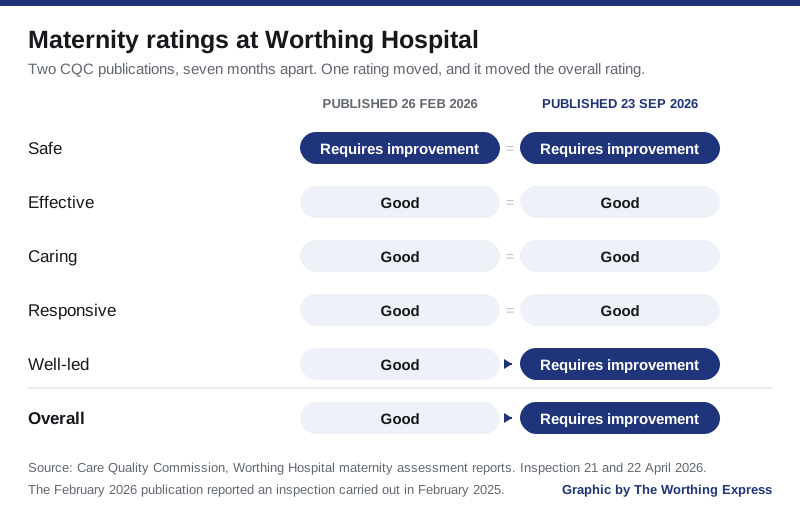
Safe has now been rated requires improvement at two assessments running.
What inspectors found
The clearest finding is about monitoring women for signs of deterioration. Inspectors read 11 sets of care records, including MEOWS charts, which are the observation charts used to spot a woman becoming unwell.
Three of the 11 showed delays in escalation and incomplete observations. The report says this “limited the service’s ability to ensure timely identification and management of risk”.
The safe section also records:
- sterile equipment past its use by date in the antenatal clinic, the postnatal ward and the bereavement suite
- a resuscitation trolley in the antenatal clinic with no suction equipment and no defibrillator, and a trolley on the postnatal ward with no defibrillator
- properly stocked trolleys that were down a corridor or behind a key card door
- two CTG machines in the antenatal bay when leaders confirmed there should have been four
- windows on the postnatal ward broken and unopenable, despite staff escalating it “over a prolonged period”
Inspectors raised the trolleys and the out of date equipment during the visit and were told both had been put right. The CTG shortfall was added to the departmental risk register afterwards, with a funding request for more machines.
On caesareans, the unit has one dedicated obstetric theatre. A second is in the main theatre department, reached by an emergency lift, and sits further from the delivery suite. Delayed category 1 emergency caesareans were the most common incident theme in the 12 months before the assessment. The report says it was not clear whether any of those incidents related to the location of the second theatre.
Safeguarding was scored 2 out of 4. Mandatory level 3 adult safeguarding training started in March 2026 and is not expected to reach all relevant staff until March 2027. CQC asked the trust for an update on compliance after the visit. The report records that the trust did not provide it.
Women waiting in a corridor
The maternity assessment and triage area has no dedicated assessment rooms. Women and whoever came with them wait in a corridor that doubles as the waiting room.
Inspectors watched women on beds being wheeled through that corridor while others had to move out of the way. Leaders told them the area had not been risk assessed.
The bereavement suite sits directly opposite. Noise reducing doors have been fitted. The report says that did not fully deal with the problem.
Privacy was a related finding. Inspectors saw staff taking observations and recording medical histories in waiting areas outside the maternity and day assessment units, where they could be overheard.
One woman told inspectors she felt she had to “exaggerate reduced fetal movements” to be taken seriously and asked to attend. Another said she was “not given enough time to ask questions”.
Leaders said they had secured funding to move the maternity assessment areas. After the inspection, the report says, the service could not provide evidence that the funding had been secured or that any plans were in place.
Governance scored 1 out of 4
The lowest score in the report is for governance, management and sustainability. CQC scores these areas from 1 to 4. The report describes 1 as “significant shortfalls”, 2 as “some shortfalls” and 3 as “a good standard”.
Well-led fell from good to requires improvement, and governance is why. The report records:
- audit midwives appointed and a schedule written, but most audits still scheduled or ongoing rather than done
- a maternity dashboard with a section for benchmarking data that leaders had not filled in, a gap already raised at the previous assessment
- some risks sitting on the risk register for more than three years without meaningful progress
- no completed review of why Worthing has the highest proportion of category 1 caesareans of the trust’s four sites
- a MEOWS audit put in the 2026 to 2027 programme but not yet carried out
Medicines scored 2. Fridge temperatures were recorded outside the required range with no evidence of escalation. Controlled drug disposal records were not always completed. Analysis of March 2026 prescribing data showed 17% of prescribed medicines had no clear record of administration, logged instead as “unable to confirm administration” or “not charted prior to discharge”.
Between September 2025 and February 2026 an average of 33% of women here had their labour induced. The service did not collect or monitor how long they waited for it.
What is working
The report is not uniformly bad, and the parts that improved matter to anyone booked to give birth here.
- Neonatal mortality rates were below the national average, which the effective section calls positive progress in outcomes for babies.
- Effective, caring and responsive all stayed good.
- Midwifery posts were fully recruited, against a national and regional vacancy rate of 3.2%. Midwifery turnover was 4.5% trust wide against 6.1% nationally. The service stopped using agency staff in November 2025.
- A 24 hour telephone triage line runs seven days a week, staffed by midwives.
- In the 2025 CQC maternity survey, which 261 women at the trust responded to, the service scored better than the national average on triage.
- The previous breach over ligature risk assessments has been closed.
- Learning culture, staffing and infection prevention were each scored 3, a good standard. Wards were clean and cleaning audits showed high compliance.
Most women who spoke to inspectors praised staff. The report quotes one saying her care was “positive and significantly better compared to her first birth experience”.
This lands in the middle of the Ockenden review
Worthing’s maternity unit is inside a much larger inquiry. On 15 April 2026 the Health Secretary appointed Donna Ockenden to chair an independent review of maternity services at University Hospitals Sussex. The trust says the review will assess the cases of more than 1,000 families from 2018 onwards, and that the scope was confirmed on 13 May 2026.
The trust has been in NHS England’s Maternity Safety Support Programme since February 2022. It had planned to leave the programme during 2025. The CQC report says that was delayed after the trust was included in a rapid national investigation into NHS maternity and neonatal services.
What the regulator and the trust say
Neither the CQC nor the trust has published a statement on its own website. Both issued one to news outlets, and the wording below is carried identically by Greatest Hits Radio and SussexWorld.
Amanda Williams, CQC deputy director of hospitals, secondary and specialist care in the South East, said: “However, it was clear that although the trust had taken some action to address concerns raised at the previous inspection, progress was slow and the service still wasn’t consistently keeping women and babies safe.”
She also said feedback from women “was consistently positive and we saw staff treating people with kindness and respect”, and that CQC had asked for an action plan and would “continue to monitor the service closely while improvements are made”.
A University Hospitals Sussex spokesperson said: “We accept the CQC’s findings and the need to continue improving our maternity services. Providing safe, high-quality care for women, babies and families is our highest priority, and we fully recognise the areas where improvements are needed.”
The spokesperson said the trust had secured funding to strengthen staffing and recruited specialist roles since the inspection, and was introducing more support in pharmacy, perinatal mental health and bereavement care.
What it means for you
If you are booked to give birth at Worthing, nothing about your booking changes. The unit has not been closed or restricted, and the CQC has taken no enforcement action. It has asked the trust for an action plan and says it will keep monitoring.
Practical points from the report worth knowing:
- The 24 hour midwife triage line runs every day of the week. Use it rather than waiting, particularly for reduced fetal movements. One woman told inspectors she felt she had to overstate her symptoms to be seen. You should not have to.
- The maternity assessment area has no dedicated assessment rooms and the corridor serves as the waiting room. Expect it to be cramped when busy, and expect to be asked to move for beds.
- Observations were missed in 3 of the 11 records inspectors read. If you are an inpatient and your observations are not being taken, or you feel you are getting worse, say so and ask for a senior midwife or the on call obstetrician.
- You can give feedback on your care directly to the CQC, and the report says the regulator uses it to decide what to inspect. The trust’s Maternity and Neonatal Voices Partnership also collects it.
- If you were treated by UHSussex maternity services from 2018 onwards, the Ockenden review is contacting families. The trust’s own maternity review page carries its updates.
Hospital parking is on Lyndhurst Road. The east car park is reserved for NHS permit holders, and the west side is pay and display, with charges in our parking in Worthing guide.
This is the second regulator’s report on Worthing Hospital this month. Last week we covered the Human Tissue Authority’s findings on the hospital mortuary, where inspectors recorded 10 major shortfalls.
Sources: Worthing Hospital maternity assessment report, published 23 September 2026, Care Quality Commission, including the safe, effective, caring and well-led sections; CQC finds improvement in maternity services at Worthing Hospital, CQC, 26 February 2026; Worthing Hospital location record, CQC; Donna Ockenden appointed to chair Sussex maternity review, Department of Health and Social Care, 15 April 2026; Maternity service reviews, University Hospitals Sussex NHS Foundation Trust.
Have your say